
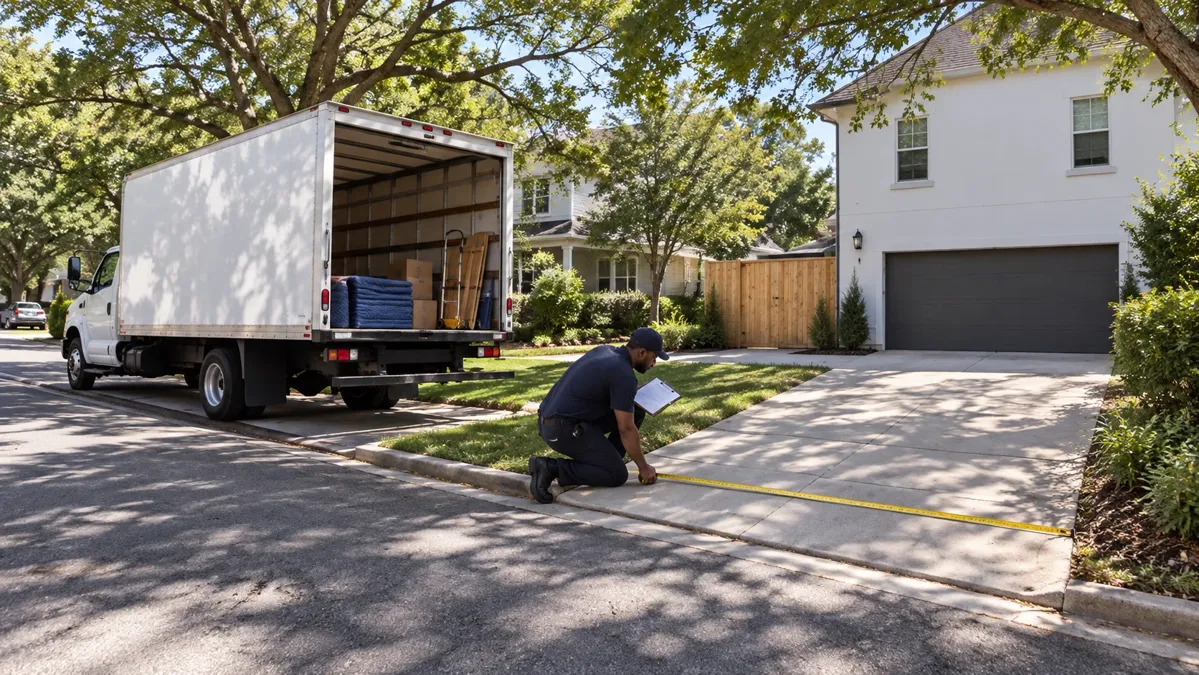
Can the Moving Truck Reach Your Home? An Access Checklist for Both Ends of an Atlanta Interstate Move
Verify truck access at both the pickup and delivery address before an interstate move from Atlanta. Use this checklist to confirm approach roads, parking, building rules, and whether the plan needs a standard truck, shuttle, or additional carrying services.
Why Access Is the First Thing to Verify
A 53-foot trailer needs a lot of room. It needs a legal place to park, enough turning radius to get in and out, and a clear path from the truck to your door. When one of those conditions fails, the move does not stop. It changes shape. The crew may need to park farther away, carry items a longer distance, or transfer everything into a smaller vehicle. Each of those changes adds labor, time, and cost.
The problem is that access is easy to overlook. Most people focus on what they own, not where the truck will stand. By the time the truck arrives and cannot reach the door, the options are limited and expensive. Checking access early is the cheapest form of move planning.
Check Both Ends, Not Just One
Pickup and delivery are equally important. A perfect driveway at the origin does not help if the destination is a downtown high-rise with no loading zone. A smooth suburban delivery does not help if the pickup street is too narrow for a large truck.
Use the same questions at both addresses.
| Question | Why it matters |
|---|---|
| Is there a legal place for a large truck to stop? | Blocking a lane or a driveway can lead to enforcement, fines, or a forced move mid-load. |
| Is the street wide enough for the truck to turn in and out? | Narrow streets and tight corners can make entry impossible even if parking exists. |
| Are there height or weight restrictions on the route or at the entrance? | Low bridges, gated communities, and weight-limited roads can block a loaded truck. |
| Is the distance from truck to door reasonable? | Long carries slow the crew and often trigger additional charges. |
| Does the building require a COI or an elevator reservation? | Without these, building management may refuse access on move day. |
| Are permits required for parking or right-of-way use? | Some cities require a permit even for a residential move. Missing one can delay the job. |
Write down the answers for both addresses side by side. The weaker end will determine the access strategy.
What Can Block a Moving Truck
The list of access blockers is shorter than people expect. Most problems fall into a few categories.
1 Street Width and Turning Radius
Older neighborhoods, historic districts, and dense urban blocks often have streets that a 53-foot trailer cannot navigate. A truck that can enter may not be able to turn around or exit without backing into traffic.
2 Low Clearance
Bridges, tunnels, parking garage entrances, and tree canopies can all have height limits below a loaded truck. A standard moving trailer can be 13 feet 6 inches tall. Anything lower is a hard stop.
3 Weight Restrictions
Some residential roads have seasonal or permanent weight limits. A fully loaded truck may exceed them even if an empty truck would not.
4 Parking and Enforcement
No-parking zones, rush-hour lanes, and permit-only blocks can prevent the truck from stopping near the door. In some cities, enforcement is active and fast.
5 Building Rules
Loading dock hours, freight elevator windows, COI requirements, and move-in fees can all restrict when and how the truck can unload.
6 Route Restrictions for Trucks
Trucks are not allowed on every road. Some highways restrict trucks over a certain size, and some local roads prohibit commercial vehicles entirely.
Check each category against both addresses. If any category raises a flag, plan for it before the estimate is finalized.
High-Rise, Walk-Up, Townhouse, House: Access by Building Type
The type of building changes the access checklist. A single-family house with a driveway is a different problem from a 30th-floor condo with a shared loading dock.
| Building type | Main access risk | What to verify |
|---|---|---|
| Single-family house | Driveway clearance, street width, low trees | Can the truck pull into or close to the driveway? Are there overhead obstacles? |
| Townhouse or row house | No driveway, shared street, limited curb space | Is street parking legal? Is there a permit requirement? How far is the carry? |
| Walk-up apartment | Stairs, narrow entry, no elevator | How many flights? Is the stairwell wide enough for furniture? Is there a ground-floor option? |
| High-rise or condo | Loading dock rules, freight elevator, COI, move-in fees | Does the building require a COI? Are elevator reservations required? What are the dock hours? |
| Gated community | Gate height or length limits, guard approval | Can a large truck pass through the gate? Is advance notice required for the guard? |
For high-rises and condos, two documents matter more than anything else: the COI and the elevator reservation. A Certificate of Insurance is a one-page document from the mover’s insurer confirming coverage. Many buildings require general liability coverage of at least $1 million per occurrence and $2 million aggregate, with the building named as a certificate holder or additional insured. Ask your building which version they need, because naming the building as an additional insured takes longer than simply listing it as a certificate holder.
Elevator reservations are usually handled through the building’s management office. The standard advice is to ask about freight elevator windows and dock hours as soon as you have a moving date. Some buildings release slots on a first-come basis, and prime windows fill quickly.
Permits and Parking: What You Need Before Moving Day
Permit rules depend on the city. For an interstate move with an Atlanta end, the delivery city is the one most likely to require attention. If the pickup is in Washington, D.C., that city has its own system.
Atlanta: Right-of-Way and Lane Closure Permits
Atlanta requires a right-of-way permit for work or occupancy in the public right-of-way. The Atlanta Department of Transportation processes these permits through an online portal. If the move requires a lane or sidewalk closure, a lane closure permit is issued at the same time. The published processing time is 10 business days once all required documents are received. Permits are not processed on weekends or holidays.
In practice, a standard residential move may not need a lane closure permit if the truck can park legally without blocking a travel lane. But if the building has no loading zone and the only option is to occupy a lane or a sidewalk, the permit becomes necessary. Missing permits can pause work and create costly downtime.
Washington, D.C.: DDOT TOPS
If the pickup is in D.C., the city requires a public space permit for any moving truck that takes up street space. This includes parking in an alley. The permit is obtained through the DDOT Transportation Online Permitting System, known as TOPS. The fee is $50, plus any metered parking fees. In many cases the application is approved automatically, but if it is not, the city advises allowing up to two weeks for processing.
No-parking signs must be posted before the truck arrives. At unmetered locations, signs go up 72 hours in advance. At metered locations, 24 hours is enough. The permit itself is issued for no longer than two days, but you can apply weeks ahead of the effective date.
Timing note. Atlanta’s 10-business-day window and D.C.’s possible two-week window both mean that permit applications should be filed as soon as a moving date is confirmed. Waiting until the week of the move can turn a manageable task into a delay.
Elevator, Dock, and COI: Building Requirements
Building requirements are often stricter than city requirements. A building can refuse access if its own rules are not met, even when the truck is parked legally and all city permits are in order.
Freight elevator reservations
Ask the management office three questions: Is a freight elevator reservation required, how far in advance can it be booked, and what is the cancellation policy. Some buildings allow a reservation weeks ahead. Others release slots on a shorter horizon. A missed elevator window can add hours to a move.
Loading dock rules
Docks may have height limits, length limits, or time-of-day restrictions. A dock that works for a delivery van may not accept a full-size moving trailer. Confirm the maximum vehicle size the dock can accommodate.
Certificate of Insurance
A COI is not a contract between you and the mover. It is proof that the mover carries insurance. Buildings ask for it because they want to know whose policy pays if something is damaged. Request the COI when you book the move, not the week of the move. Management offices keep business hours, and move day does not.
When the Truck Cannot Reach: Shuttle and Carry Options
If the main truck cannot reach the door, the move does not stop. It switches to a shuttle. A shuttle is a smaller truck that ferries items between the main truck and the residence. The main truck parks at the nearest accessible point, and the smaller vehicle makes repeated trips.
Shuttle service is one of the most expensive accessorial charges in moving because it doubles the handling of every item. Published ranges put the cost at roughly $300 to $700 or more per location, depending on distance and the number of trips. Some movers use a flat rate per location, while others charge by weight or by the number of shuttle runs.
A shuttle is typically required when the street is too narrow, the bridge or tunnel is too low, the road has a weight limit, or the building’s loading dock cannot accept the main truck. If a shuttle is likely, it should appear as a named line item on the estimate with a clear trigger condition. A good estimate will say something like: “Shuttle fee may apply if truck access is restricted at destination.”
Long carries are a related charge. A long carry applies when the truck can park close enough, but the distance from truck to door exceeds what the mover considers reasonable. Some movers include a certain number of feet for free and charge per additional increment. The exact threshold varies by company and should be confirmed before booking.
How to check for shuttle risk before the estimate. A video walkthrough is the fastest method. If a video is not possible, use satellite imagery and Street View to look at street width, overhead obstacles, and whether large vehicles appear in the neighborhood. For high-rises, call the building manager and ask about truck size limits and dock dimensions.
Remote Access Check: How to Verify Without Being There
Many people plan a move from a different city. You cannot always visit the pickup or delivery address before move day. Remote verification is possible if you use the right tools.
- Start with Street View, not satellite. Satellite imagery shows layout, but Street View shows height. Look for overhead wires, tree canopies, low bridges, and the actual width of the street compared to parked cars.
- Check the route for truck restrictions. In Georgia, trucks are not allowed inside the perimeter of Atlanta on I-75, I-85, or I-20 unless they are making a pickup or delivery inside I-285. Trucks traveling through the city must use I-285. If the delivery address is inside the perimeter, the truck can enter for the delivery, but the route must be planned accordingly.
- Check express lane rules. Vehicles with more than two axles or six wheels are not allowed in the I-85 Express Lanes. A standard moving truck will not qualify. The truck must use general-purpose lanes.
- Call the city if the street looks narrow. A quick call to the local transportation department or a look at the city’s right-of-way rules can clarify whether a permit is required for a truck to stop on the street.
- Call the building. For any multi-unit building, the management office is the best source of information about dock rules, elevator reservations, COI requirements, and move-in fees.
- Ask the mover for a video survey. Many interstate movers now offer virtual walkthroughs. The estimator can flag access problems that are hard to see from a map.
Remote checks are not perfect, but they catch the major blockers. A low bridge or a narrow street is visible on Street View. A building’s COI requirement is one phone call away.
Access Checklist
Use this checklist for both the pickup and the delivery address. If an item does not apply, mark it as not applicable. If it applies and you cannot verify it, treat it as a risk.
Street and route
Street wide enough for a large truck. No low bridges or tunnels on the approach. No weight-restricted roads. Truck restrictions on the highway route checked.
Parking and permits
Legal place for the truck to stop. Permit required by the city. No-parking signs posted on time. Rush-hour or street-sweeping restrictions checked.
Building access
Loading dock available and suitable for truck size. Freight elevator reservation confirmed. COI requested and sent to management. Move-in fee paid if required.
Distance and carry
Distance from truck to door measured. Long-carry threshold confirmed with the mover. Stairs, corners, and door widths checked for large items.
Shuttle risk
Any condition that could trigger a shuttle identified. Shuttle fee range confirmed. Contingency noted on the estimate.
Timing
Move date confirmed. Permit processing time accounted for. Elevator window booked. No conflicts with building move-in hours.
Frequently Asked Questions
Pros and Cons of Access Planning
Where access planning pays off
- You find out about a shuttle before the estimate is final, not on move day.
- Permit timelines become part of the schedule instead of a surprise.
- Building requirements are confirmed in writing before the crew arrives.
- A remote Street View check takes minutes and can reveal a hard blocker.
- The mover can plan the route around truck restrictions instead of discovering them en route.
Where access planning has limits
- Street View can be outdated. A new construction barrier or a changed traffic pattern may not appear.
- A building’s rules can change between the reservation and move day.
- A permit does not guarantee a parking space. Another vehicle can still occupy the reserved area.
- A shuttle fee cannot always be avoided. Some addresses simply cannot accept a large truck.
- Remote checks reduce risk but do not replace an on-site survey for complex addresses.
The honest position is this: access planning lowers the chance of a costly surprise, but it does not eliminate every variable. The goal is to identify the risks that can be identified and to have a plan for the ones that cannot.
Final note
The access question is not about whether your belongings will fit on the truck. It is about whether the truck can reach the door. Check both ends, use the tools available remotely, confirm the building rules in writing, and treat permit timelines as part of the move schedule. If a shuttle is possible, get the trigger condition in writing. That is the difference between a move that runs on a plan and a move that runs on damage control.