
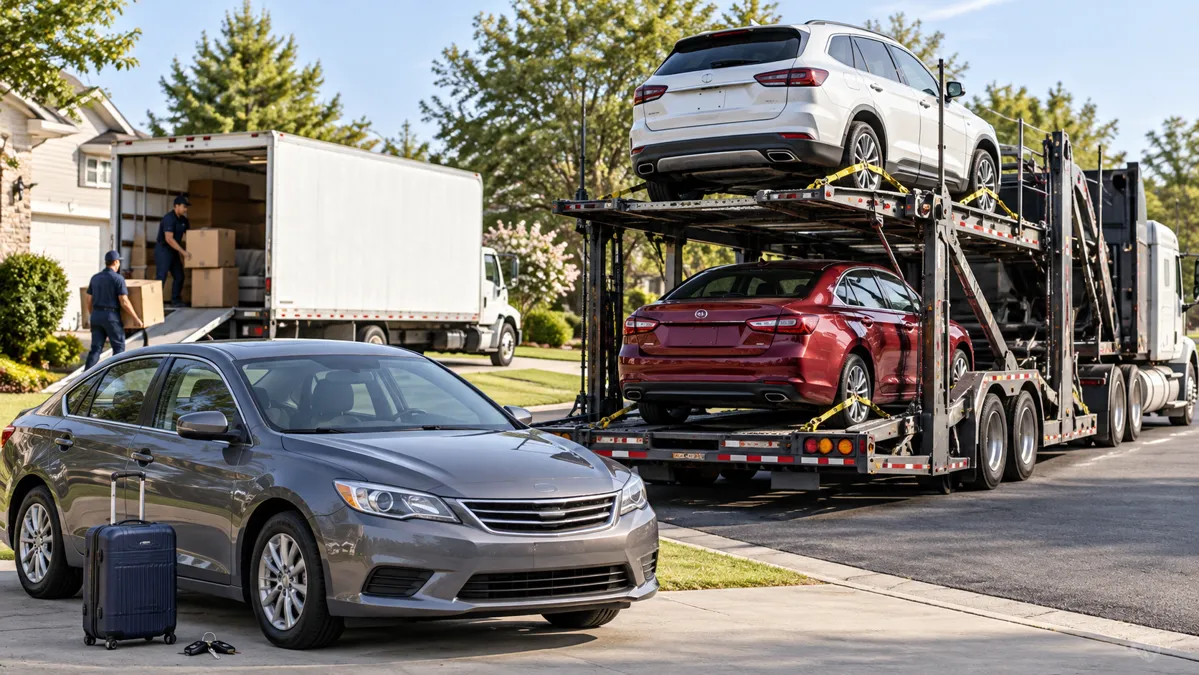
Ship Your Car or Drive It? Coordinating Vehicle Transport with an Atlanta Long-Distance Move
Compare the full driving budget with vehicle shipping quotes for a long-distance move from Atlanta. Include fuel, travel time, lodging, tolls, vehicle use, and local transport while the car is in transit. Coordinate the pickup and delivery windows with your household move.
The real cost of driving from Atlanta (with lost wages included)
Most cost comparisons stop at gas, hotels, and meals. That leaves out the two largest expenses: what your time is worth and what those miles do to your car’s value. Here is what a two-day drive actually costs when you count everything.
The IRS standard mileage rate for 2026 is 72.5 cents per mile. That rate covers fuel, depreciation, maintenance, and wear on your vehicle. For a 700-mile drive, the vehicle-related cost alone runs about $508. For a 1,400-mile drive, it climbs to roughly $1,015. This is the number to use when comparing driving against a shipping quote. It reflects what you actually spend to operate your car, mile for mile.
Lost wages are the other missing piece. The median annual wage in Georgia is $64,200, which works out to about $247 per workday. A two-day drive removes $494 from your paycheck. A three-day drive removes $741. For a household with two working adults both making the drive, those numbers double.
| Cost component | 700-mile drive (2 days) | 1,400-mile drive (3 days) |
|---|---|---|
| Vehicle cost (IRS rate 72.5¢/mile) | $508 | $1,015 |
| Lost wages (1 person) | $494 | $741 |
| Hotels and meals | $250 to $350 | $400 to $550 |
| Tolls (Atlanta express lanes) | $3 to $10 | $3 to $10 |
| Total driving cost | $1,255 to $1,362 | $2,159 to $2,316 |
What most people miss: Gas is rarely more than 10 to 15 percent of the true driving cost. The bulk comes from depreciation and your time. If you are taking unpaid leave or using vacation days, that time has a dollar value even if it does not show up on a receipt.
What car shipping from or to Atlanta actually costs
Shipping prices from Atlanta depend on distance, carrier type, and season. The ranges below reflect open transport for a standard sedan in normal market conditions. Enclosed transport runs 40 to 60 percent higher and makes sense for vehicles worth more than $50,000, classics, and new EVs.
| Route | Distance | Open transport | Transit time |
|---|---|---|---|
| Atlanta to Miami | ~660 mi | $400 to $825 | 2 to 4 days |
| Atlanta to Chicago | ~715 mi | $746 to $1,065 | 2 to 6 days |
| Atlanta to New York | ~870 mi | $700 to $1,000 | 3 to 5 days |
| Atlanta to Denver | ~1,400 mi | $850 to $1,750 | 4 to 6 days |
| Atlanta to Seattle | ~2,636 mi | $1,325 to $2,618 | 5 to 9 days |
Summer months (June through August) add 15 to 25 percent to these rates because demand peaks. January and February are the cheapest months to ship. Booking two to three weeks in advance gives you the best selection of carriers and pickup windows.
Side-by-side: full cost comparison for three Atlanta routes
Here is how the numbers stack up when you compare driving against shipping for the same three routes. Driving costs include the IRS vehicle rate, lost wages for one person, hotels, meals, and tolls. Shipping costs use the midpoint of the open transport range.
| Route | Driving cost | Shipping cost | Difference | What you save |
|---|---|---|---|---|
| Atlanta to Miami (2 days) | $1,255 | $610 | $645 | Shipping saves $645 |
| Atlanta to Chicago (2 days) | $1,280 | $905 | $375 | Shipping saves $375 |
| Atlanta to Denver (3 days) | $2,159 | $1,300 | $859 | Shipping saves $859 |
On every route tested, shipping costs less than driving once you count lost wages and the full IRS vehicle rate. The gap widens with distance. On a long cross-country route, shipping can save you more than $800 and three full days of your life.
When shipping makes more sense than driving (and when it does not)
The decision is not purely financial. Some situations favor driving even when the math says shipping is cheaper. Here is how to sort it out.
1 Ship if you have a tight work schedule
If you cannot take two or three days off without losing income or falling behind, shipping wins. You fly to your new city, your car arrives within a few days, and you lose zero workdays.
2 Ship if your car is new, leased, or high-value
Every mile reduces resale value. If you are turning in a lease or selling a car within a few years, shipping protects that value. Enclosed transport is worth the premium for vehicles above $50,000.
3 Ship if you have more than one vehicle
Coordinating two drivers for a long move is expensive and exhausting. Shipping one car while you drive the other is often the simplest solution. Some families ship both and fly.
4 Drive if the move is under 400 miles
On short routes, the shipping minimum charge and pickup logistics can eat the savings. If you can complete the drive in one day without an overnight stop, driving is usually the better call.
5 Drive if your car is not worth much
On an older, high-mileage vehicle, additional depreciation matters less. If the car is worth under $5,000, the financial argument for shipping weakens considerably.
6 Drive if you need the car immediately
Shipping takes 2 to 9 days depending on distance. If you need your car the moment you arrive for work, school, or family logistics, driving gives you control over timing.
Coordinating car shipping with your Atlanta move
The biggest source of stress with car shipping is not the carrier. It is the timing. Your car needs to leave Atlanta at the right moment and arrive at your new home when you can actually receive it. Here is a timeline that works for most long-distance moves.
- Three weeks before the move: Get quotes from at least three carriers. Ask about pickup windows in Atlanta and delivery windows at your destination. Confirm whether the quote is binding or subject to change.
- Two weeks before: Book your carrier. Ask for a pickup date two to three days before your household goods are scheduled to leave. This gives the carrier flexibility and reduces the chance of a delay.
- One week before: Confirm the pickup window. Clean out your car completely. Carriers do not cover personal items left in the vehicle, and most prohibit packing household goods in the car.
- Pickup day: Do a walkaround inspection with the driver. Note any existing scratches, dents, or chips on the bill of lading. Take photos. Keep a copy of the signed document.
- During transit: Ask for the driver’s contact information and an estimated delivery window. Most carriers provide updates by text or phone. If you are flying to your destination, time your arrival for the day after the estimated delivery window opens.
- Delivery day: Inspect the car before signing anything. Compare the condition against your pickup photos. If there is new damage, note it on the delivery receipt and file a claim before the driver leaves.
If your car arrives before you do: Ask the carrier if they can hold the vehicle for a day or two. Some carriers charge a storage fee, usually $20 to $40 per day. Budget for this possibility if your flights and delivery windows are tight.
Common mistakes when deciding
Comparing only gas against a shipping quote
Gas is the smallest part of the driving cost. If you compare a $120 fuel bill against an $800 shipping quote, driving looks like a bargain. Add depreciation, lost wages, hotels, and meals, and the gap disappears.
Ignoring the cost of your time
If you earn $250 per day, a two-day drive costs $500 in lost wages. That is more than the fuel bill and often more than the hotel bill. Your time has a price even if you do not see it on an invoice.
Packing belongings in the car
Carriers prohibit household goods in vehicles. Items left in the car are not covered by insurance. If something goes missing or gets damaged, you have no recourse. Ship your belongings separately.
Booking shipping too late in peak season
June through August is the busiest moving season. Rates rise 15 to 25 percent and pickup windows tighten. Booking two to three weeks in advance gives you more options and better prices.
Not checking the carrier’s insurance
All licensed carriers must carry liability insurance. Ask for the carrier’s MC number and verify it on the FMCSA website. Confirm what the policy covers and what your own auto insurance covers during transit.
Assuming the car will arrive on the exact day
Car shipping is not like a package delivery. Weather, traffic, and carrier schedules can shift delivery by a day or two. Build a buffer into your plans, especially if you are flying to your destination.
Quick Comparison for Your Atlanta Move
| Your situation | What to do |
|---|---|
| Move is 500+ miles, you have a job start date | Ship it. You cannot afford the lost wages. |
| Car is leased, financed, or worth $30,000+ | Ship it. Protect the resale value. |
| Move is under 400 miles, you can drive in one day | Drive it. Shipping minimums and logistics eat the savings. |
| You have two cars and two drivers | Ship one, drive one. Or ship both and fly. |
| Car is older, worth under $5,000 | Drive it. Additional depreciation is minimal. |
| You need the car immediately on arrival | Drive it. Shipping adds 2 to 9 days. |
| You have a flexible schedule and want to see the country | Drive it. Turn the move into a road trip. |
Pros and cons
Shipping your car
- Saves two to four days of travel time and lost wages
- Protects your car’s resale value by keeping miles off the odometer
- No risk of breakdowns, weather delays, or fatigue on the road
- You can fly to your new city and start work immediately
- Enclosed transport available for high-value vehicles
Driving your car
- You spend two to four days on the road instead of working or settling in
- Your car accumulates hundreds or thousands of miles of wear
- You pay for hotels, meals, and tolls out of pocket
- You risk breakdowns, bad weather, and traffic delays
- The “savings” on shipping often disappear once you count your time
For most long-distance moves involving Atlanta, shipping is the financially smarter choice. The exceptions are short routes, low-value vehicles, and situations where you genuinely need the car the moment you arrive. Run the numbers for your specific route and paycheck. The answer is usually clearer than you expect.